Kazinga Channel vs Nile Boat Safari: Compared by Locals
September 18, 2026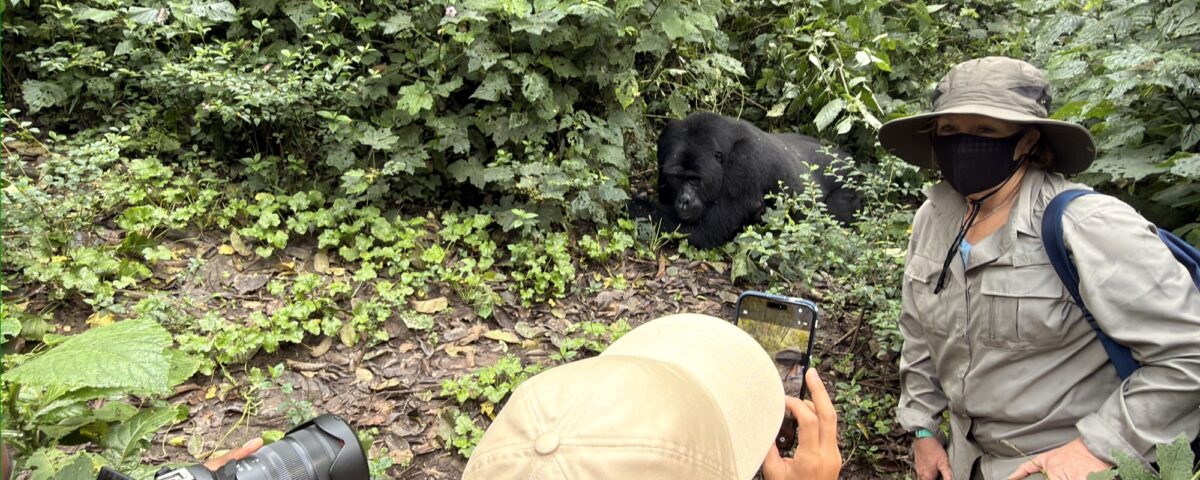
A note from the writer: I joined a Uganda safari organised by Jackal Adventures Africa as part of a working trip in Uganda. I wasn’t travelling as a regular holidaymaker — I was there partly for work, but I experienced the safari and gorilla trek as a traveller would. This article is my personal account of what the experience was actually like on the ground.
Gorilla trekking is one of those experiences that is surprisingly difficult to understand until you’ve actually done it. Before my trip, I had already read about it. I knew the trek could potentially take several hours. I knew I needed proper shoes, gaiters, gloves and rain protection. I had seen plenty of photos and videos of people standing surprisingly close to enormous mountain gorillas.
But knowing all of that still didn’t really tell me what the experience would be like.
I went to Uganda in March as part of a longer safari through the country. It wasn’t my first time in Uganda, but it was my first proper Uganda safari and definitely my first time going gorilla trekking. One of the biggest things I learned is that your gorilla trekking experience can be completely different from the person who did exactly the same thing the day before.
Someone in my group had gone gorilla trekking the previous day and spent around four hours in the forest. She described her trek as tough. Mine? We found the gorillas in roughly 30 minutes.
That’s probably the first thing anyone planning a gorilla trek needs to understand: nature decides what kind of trek you’re going to have.
Arriving in Bwindi Impenetrable National Park
My gorilla trek took place in Bwindi Impenetrable National Park, in the Rushaga sector. We arrived in the area the previous day and stayed at Rushaga Gorilla Lodge, which meant we could wake up, have breakfast and head directly to the trekking point the following morning.
We left the lodge at around 7:30 AM and drove approximately 1 to 2 kilometres to the starting point. I don’t remember the morning feeling painfully early at all. We had time to eat breakfast, and because we were returning to the same lodge afterwards, we didn’t have to pack everything and check out before leaving. That made the morning feel surprisingly relaxed considering this was the day we’d been building up to.
The Experience Starts Before You Enter the Forest
When we arrived at the starting point, there were local women singing and dancing. Yes, it was clearly arranged for tourists, but I actually liked the atmosphere. It didn’t feel pushy. The women had their own area where they performed and displayed souvenirs, and nobody followed us around trying to convince us to buy something. If you wanted a souvenir, you approached them. If you simply enjoyed the performance and wanted to leave a tip, you could do that too.
I thought it was a nice way for tourism to provide another source of income for the community without turning the experience into a hard sell. Everything else at the starting point felt well organised too. Before heading into the forest, we had a briefing covering what to expect, how to behave around the gorillas and the rules we needed to follow.
This is also where your regular safari guide essentially hands you over to the trekking team. Our safari guide and driver, Ashraf, had been with us throughout the trip. He’s a very upbeat, funny guy, and by this point we’d already spent quite a bit of time together. But he wasn’t the person taking us into the forest.
He dropped us off, made sure we met the right people, and then stayed behind. From there, we were accompanied by the park’s trekking team, including rangers who were responsible for leading us through the forest and managing the encounter once we reached the gorillas. When we eventually returned, Ashraf was waiting for us at exactly the same place.
Our particular group had four visitors. I don’t know exactly how the groups were assigned; we were simply told which group to join, and off we went. Nobody asked me about my fitness that morning either. However, if you have any mobility or fitness concerns, I would definitely mention them to your tour operator well before trekking day. They can’t control where the gorillas will be, but if there’s anything they can do to make the experience more manageable, they need to know before you start walking.
I Hired a Porter — Even Though My Trek Ended Up Being Very Short
We also hired a porter for $20 USD. Porters can carry whatever you don’t want to carry yourself — your backpack, water, camera equipment, and other gear — but I quickly realised they’re useful for more than carrying bags.
They can also physically help you through difficult sections. There were points where our porter offered a hand while we were going up or down steeper areas. If the ground had been wetter, I could easily imagine some parts becoming quite slippery. Once we were getting close to the gorillas, the porter remained behind while we continued with the rangers for the actual encounter.
Considering that we found our gorillas after only around 30 minutes, you could argue that I didn’t really need a porter. I’d still hire one again. If your trek ends up lasting four or five hours, that extra pair of hands could become very useful.
There’s another reason too. Hiring a porter is one of the ways visitors can directly support people living around the park. Even if you’re perfectly capable of carrying your own small backpack, you’re providing someone with work.
What the Terrain Is Actually Like
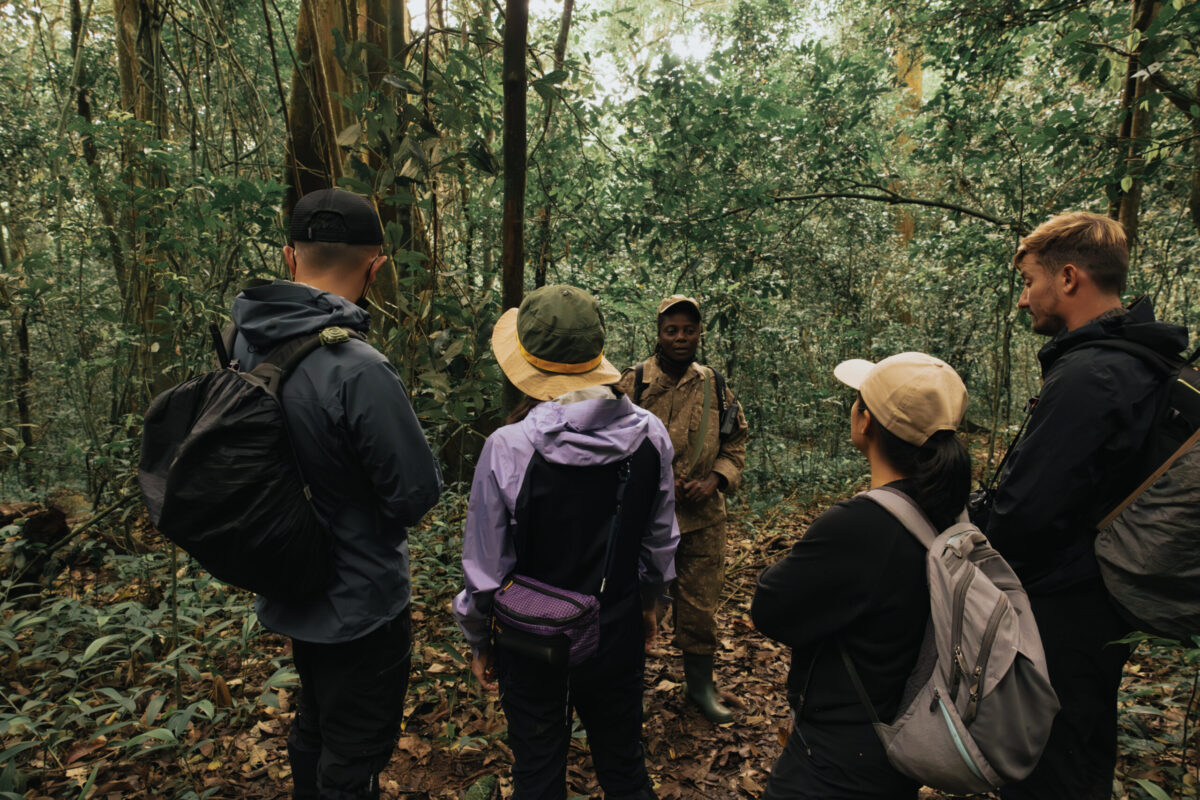
This is something that’s difficult to understand from photographs because you’re not necessarily walking along a perfectly maintained hiking trail. There was plenty of going up and down, some vegetation was waist-high, and there were sections where the trekking team had to clear vegetation to make a way for us to pass.
Nothing felt extreme during my trek, but it wasn’t exactly a walk in the park either. I remember using vegetation around me for stability and sometimes grabbing onto it to help pull myself upwards. This is why gloves ended up being one of the things I was particularly glad I’d brought.
While my own experience was relatively easy, I could immediately understand why someone who had been doing this for four hours might describe it as exhausting. The woman in our group who had trekked the previous day had experienced exactly that. Her trek had lasted several hours, and she’d found it tough. Then she came back and did it all over again the next morning. That tells you a lot about both the unpredictability of gorilla trekking and how special people find the experience once they’ve done it.
So, How Fit Do You Need to Be?
I don’t think you need to be extremely athletic to go gorilla trekking. In fact, more than half of the people I saw doing it were older travellers. But I also wouldn’t describe it as an easy stroll.
A reasonable level of fitness helps because the terrain can involve climbing, descending, mud and uneven ground. The biggest uncertainty isn’t necessarily the difficulty of any individual section; it’s how long you’ll be doing it. You might find the gorillas quickly, like we did, or you might still be walking several hours later.
If my trek had continued for four hours over the terrain we experienced, I could definitely imagine being exhausted and wanting a break. That’s why I don’t think anyone can honestly tell you exactly how difficult your gorilla trek will be. If fitness or mobility is something you’re worried about, tell your tour operator before your trip. It’s much better for them to know in advance than for you to arrive at the trekking point and hope for the best.
What I Would Actually Wear for Gorilla Trekking
We rented gaiters directly from our lodge. Do you absolutely need gaiters? After my particular trek, I’m still not entirely convinced that I did. But I think they’re one of those things you don’t think you need until you encounter mud, insects or vegetation and suddenly wish you’d worn them. So I’d wear them again.
My shoes were actually not the shoes I’d originally intended to use. Something happened with my footwear before the trek, so I ended up wearing a heavier pair than I would normally choose. If I were doing it again, I’d choose lightweight, waterproof hiking shoes with good grip and ankle support.
I’d also bring long trousers, lightweight gloves, rain protection, a small backpack, water and a few snacks. The gloves were particularly useful because there were points where I needed to hold onto vegetation for stability.
And that’s about it. You don’t need to carry your entire life into the forest. If you’re bringing an expensive camera, make sure you have something to protect it if it rains. And unless you’re a professional photographer who already knows exactly what you’re signing up for, think carefully before carrying very heavy equipment. You could potentially be carrying it for hours.
Then, After About 30 Minutes, Everything Changed
I’d mentally prepared myself for a long walk. I’d heard enough stories about people trekking for several hours that I assumed we’d be doing the same. We weren’t.
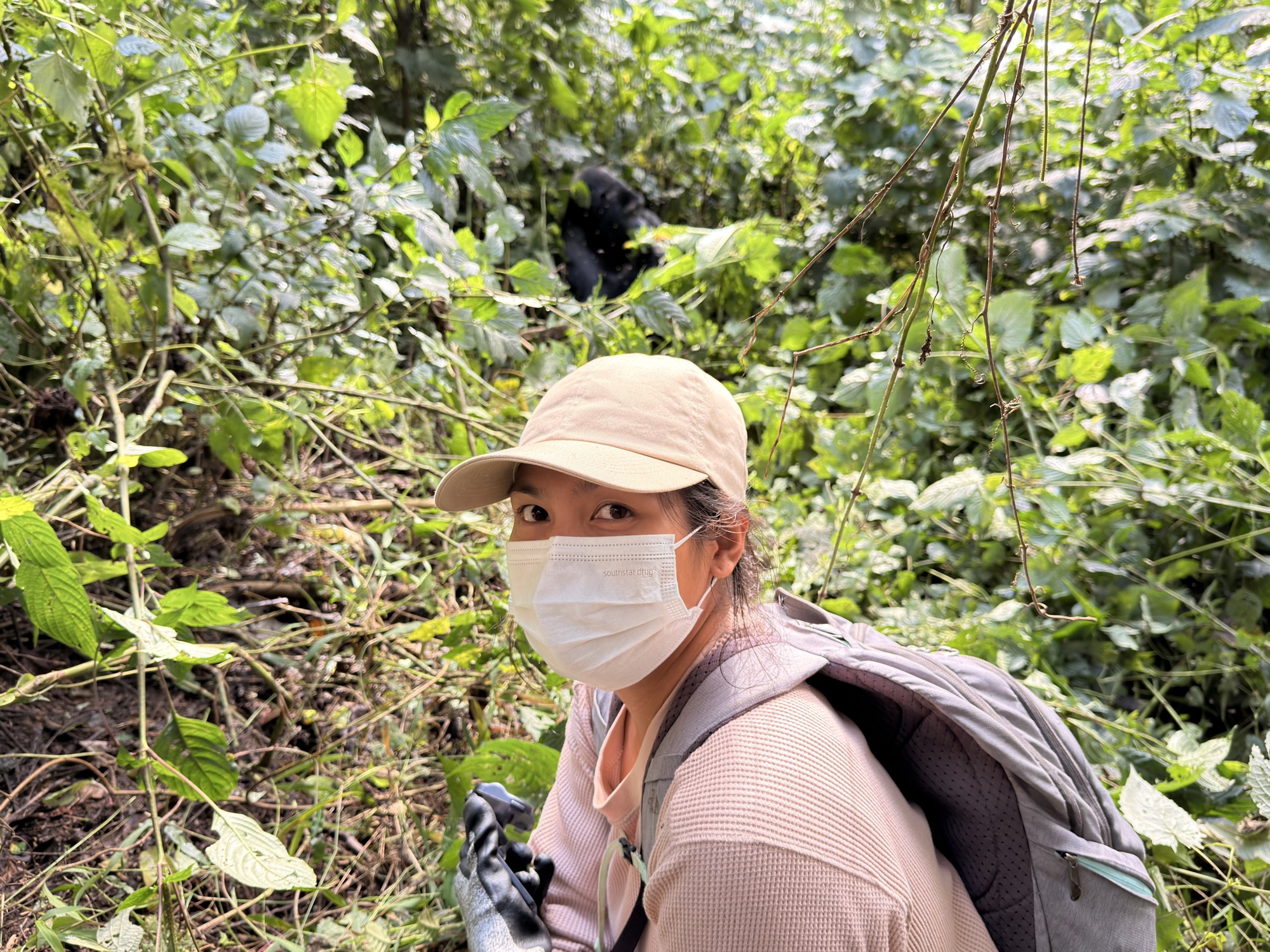
After roughly 30 minutes, the ranger stopped. They had found the gorillas. There’s a strange change in atmosphere when that happens. One moment you’re concentrating on where you’re putting your feet and following everyone through the vegetation. Then you’re told to be quiet. You put your mask on. And somewhere just ahead of you is an actual mountain gorilla. It genuinely feels a little like walking into a scene from a film, except there isn’t a screen anymore.
Nothing Prepares You for Their Size
You already know gorillas are enormous. You’ve seen photographs, watched documentaries and probably watched countless videos online before booking the trip. So you’d think their size wouldn’t surprise you. It does.
Seeing a mountain gorilla sitting just metres away in its natural environment is completely different from seeing one on a screen. Mountain gorillas are endangered and survive naturally in only a small part of East-Central Africa. Uganda is one of only three countries where mountain gorillas live in the wild, with Uganda’s populations found in Bwindi Impenetrable National Park and Mgahinga Gorilla National Park.
Standing there suddenly makes that fact feel much less abstract. You’re not looking through an enclosure. You’re standing inside their habitat. You’re the visitor.
Then the Ranger Started Making Gorilla Sounds
One of the moments I remember most clearly happened shortly after we found them. At one point, one of the gorillas made a sound. Then the ranger answered — with another gorilla sound. For a second, I remember thinking: what exactly is happening here?
From what I understood at the time, the gorilla’s sound was defensive, and the ranger was responding in a way intended to calm or reassure it, almost as though he were communicating that we weren’t there to cause harm. I don’t want to pretend I can interpret gorilla language after one trek, but as a visitor standing there watching it happen, it was surreal.
The gorilla eventually seemed to relax and went back to what it had been doing. That exchange was probably one of the moments that stayed with me most. You can read about gorilla behaviour beforehand, but watching a ranger respond to a wild gorilla using sounds while you’re standing just metres away is completely different.
Watching a Gorilla Family Simply Being a Family
The gorilla wasn’t alone. There was a family nearby, including a mother and baby. And strangely, they didn’t need to do anything particularly dramatic for the experience to be incredible. They were simply being gorillas.
They rested. They moved around. The mother stayed near her baby. As they moved through the vegetation, we moved too, always following the instructions of the rangers. We maintained the required distance and didn’t deliberately approach them. This is worth explaining because social media sometimes gives a very different impression. You’ve probably seen those incredible photographs where a gorilla appears to be right beside someone, but visitors aren’t supposed to deliberately walk up to a gorilla to get that photograph. You follow the distance rules and listen to the rangers.
Gorillas obviously don’t know how many metres humans have been told to keep away from them. If a gorilla decides to move closer, that’s different. And that’s exactly why you listen to the people who understand their behaviour instead of trying to recreate something you’ve seen on Instagram.
One Hour Goes Surprisingly Fast
Once you’ve located the gorilla family, standard gorilla trekking allows you approximately one hour with them. And I’m going to say it: one hour feels short.
You’ve travelled all the way to Uganda. You’ve paid for the permit. You’ve driven across the country. You’ve prepared yourself for potentially several hours of hiking. Then suddenly you’re standing in front of the thing you’ve come all this way to see, and the clock is ticking.
At the same time, I understand why there has to be a limit. We’re visiting their habitat, not the other way around, and one hour is still enough time to experience something remarkable. I think it felt particularly short for me because our trek itself had also been so short. Perhaps if I’d spent four hours looking for them, the entire experience would have felt considerably longer.
We were also particularly fortunate on our way back. We encountered the gorillas again, and this time we saw the mother lying down surprisingly close to where we were passing. We were able to stop and watch for a little longer, which felt like a small bonus at the end of the experience.
Take the Photo. Then Put Your Phone Down.
You can absolutely get good gorilla photos with your phone. You don’t need professional equipment just to come home with something worth keeping. But if there’s one thing I’d recommend, it’s this: take a few photos, take a short video, then put your phone down.
You don’t need 100 videos of the same gorilla. I think we sometimes make the mistake of experiencing extraordinary things through our screens because we’re so focused on making sure we’ve documented them. But how many of those videos are you realistically going to play again?
Take enough to remember the moment, then look at the gorilla with your own eyes. Years later, I don’t think the thing you’ll remember most is the 47th video sitting somewhere in your camera roll. You’ll remember what it felt like when you looked up and realised there was an enormous mountain gorilla sitting right there.
You Don’t Wear the Mask for the Entire Trek
This was another thing I had wondered about before doing it. If you’re trekking uphill for several hours, do you really have to do all of that while wearing a mask? In our case, no. We put our masks on once the gorillas had been located and we were approaching them. We didn’t wear them throughout the entire hike, so there was no issue with trying to trek uphill for hours while wearing a mask.
Of course, health protocols can change, so whatever the current rules are when you visit, follow the ranger’s instructions on the day.
The Certificate at the End
Once our trek was finished, we walked back out and found Ashraf waiting where he’d dropped us off. We were also given certificates for completing the gorilla trek. Is it mostly ceremonial? Of course. Did we still take photos holding them? Also yes. It’s actually a nice little souvenir from the experience.
I’d also recommend preparing some small bills for tipping. A good amount to prepare is approximately $80 USD. Having smaller notes makes things much easier because there may be several people you’d like to tip, including your porter and members of the trekking team. If you’re unsure about how much to give or how it should be distributed, ask your safari guide beforehand. The important thing is to think about it before you disappear into the forest rather than finishing your trek and suddenly realising all you have are large notes.
Would I Do Gorilla Trekking Again?
Yes. Maybe not the next morning like the woman in our group did, but I’d absolutely do it again.
I’d particularly like to return when my children are older because this is exactly the kind of experience I’d like to share with people I love. The minimum age for gorilla trekking in Uganda is currently 15, and after doing it myself, I think that’s completely reasonable.
You’re entering the habitat of an endangered wild animal. You need to be able to follow instructions, stay quiet when required and behave appropriately if an animal suddenly moves towards you. So this isn’t something I’d currently plan into a Uganda family trip with my young children. But when they’re older? Definitely.
One Thing I Appreciated After Seven Days in Uganda
Spending seven days on safari also made me realise how much happens behind the scenes that you don’t notice when everything is going well. My experience with Jackal Adventures was very good. People were on time, arrangements were in place, and when small changes or mishaps came up, the team was accommodating.
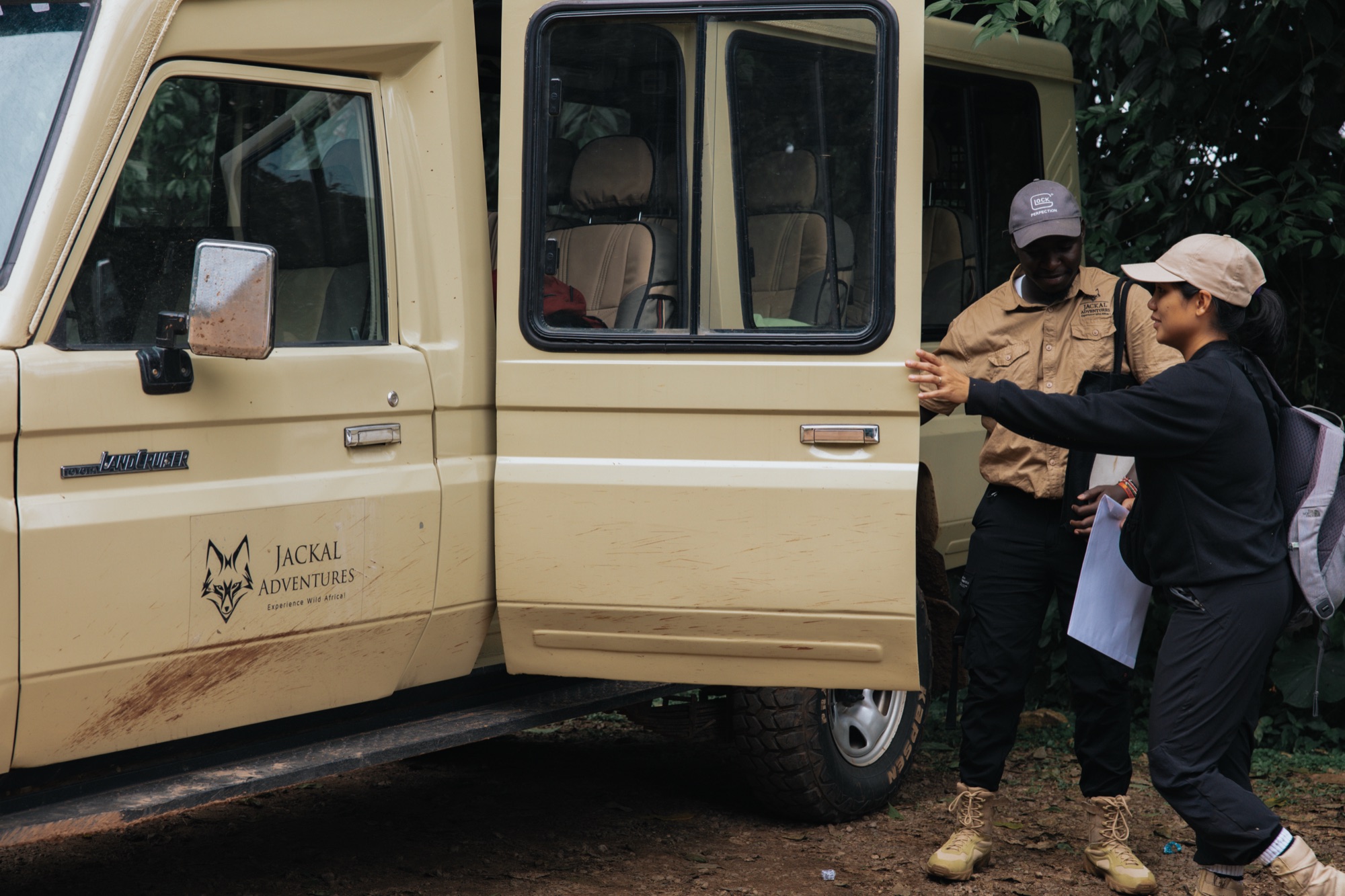
I also learned afterwards that Jackal owns its safari vehicles. It wasn’t something I’d considered when choosing the company, but after seeing how much a safari depends on vehicles, logistics and people being where they’re supposed to be, I understand why these things matter.
It also reinforced something I’d pay much more attention to when booking another safari: not choosing based on price alone. Registration, independent reviews, experience and accountability matter because many safaris can look very similar on paper. You may only really see the difference when something doesn’t go according to plan.
Is Gorilla Trekking in Uganda Worth It?
If you genuinely appreciate wildlife — and particularly if you have a special interest in primates — I think gorilla trekking is one of those experiences worth doing at least once. Just don’t arrive expecting the exact experience you saw someone else have online.
You might trek for hours. You might find the gorillas in 30 minutes. It might rain. You might get muddy. You might be extremely grateful you hired a porter. Or, like me, you might reach the gorillas so quickly that part of you actually wishes the trek had lasted a little longer.
There are people monitoring the habituated gorilla families, which gives the trekking teams an idea of where a family was previously observed and where they might begin looking the following day. But nobody can tell a wild gorilla where it needs to be waiting when you arrive.
And that’s the part of gorilla trekking that I don’t think comes across in the beautiful photographs. Nature still decides what kind of day you’re going to have. For me, the walking part ended much sooner than I’d expected. I remember initially feeling slightly disappointed. I’d prepared myself for an adventure through the forest, and suddenly, barely half an hour later, we’d already found them.
Then I looked up. There was an enormous mountain gorilla sitting there. And suddenly, how long we’d walked didn’t matter very much.